How Scan to BIM Services Help Restore Historical and Heritage Building Projects Accurately
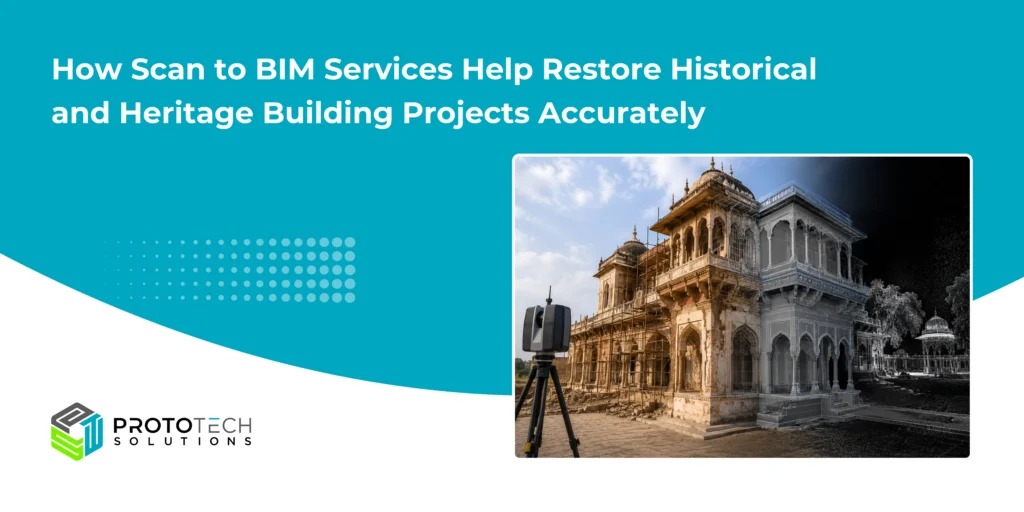
Historical and heritage structures represent the architectural identity, craftsmanship, and cultural history of civilizations. However, preserving and restoring these aging structures is a highly complex process. Damaged architectural details, missing drawings, structural deterioration, and inaccurate documentation often make restoration projects challenging for architects, engineers, and conservation specialists.
At ProtoTech Solutions, we have worked on heritage restoration projects by delivering accurate Scan to BIM services for historical structures and conservation workflows. Our experience in point cloud processing, BIM modeling, and restoration-focused documentation has helped project teams digitally preserve existing structures while improving restoration planning accuracy. By converting laser scan data into intelligent BIM models, we help architects and engineers minimize design conflicts, improve coordination, and maintain historical integrity throughout restoration projects.
Understanding Scan to BIM for Heritage Restoration
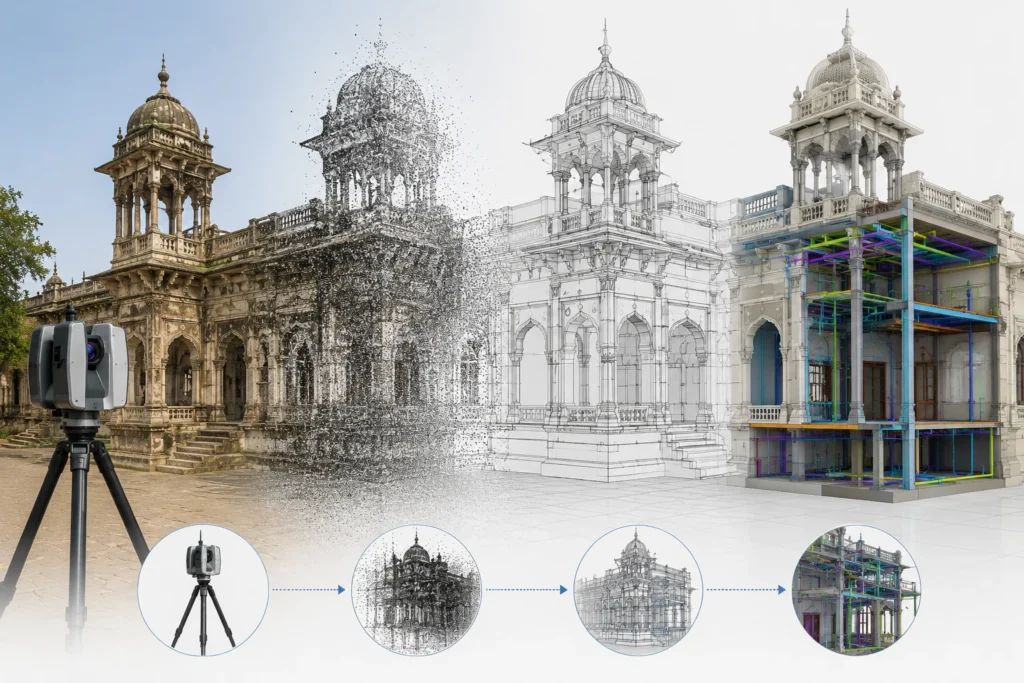
Scan to BIM is the process of capturing real-world building conditions using advanced laser scanning or photogrammetry technology and converting the collected point cloud data into an accurate Building Information Modeling (BIM) model.
For historical and heritage buildings, this process is especially valuable because many old structures lack updated architectural drawings or accurate documentation. Over decades or centuries, buildings may undergo multiple renovations, repairs, or structural deformations that are never properly recorded.
Using Scan to BIM technology, restoration teams can create precise digital representations of the building, including:
- Walls and structural components
- Ornamental architectural details
- Roof structures
- Doors and windows
- Decorative facades
- Arches and columns
- Mechanical and electrical layouts
- Structural damages and deformations
This highly accurate digital model becomes the foundation for restoration planning, conservation analysis, and renovation execution.
Why Traditional Restoration Methods Create Challenges
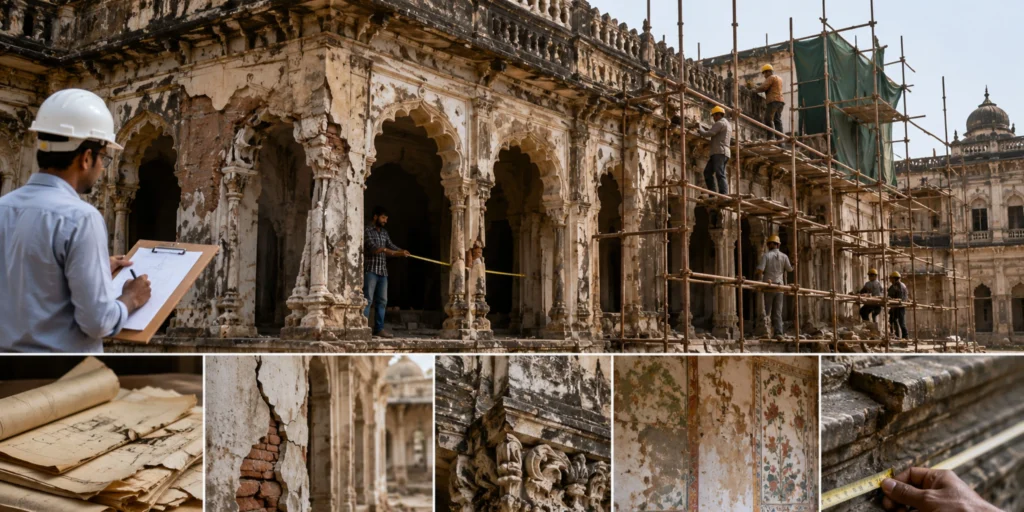
Traditional surveying and manual measurement methods are time-consuming and often fail to capture the complete complexity of historical structures. Heritage buildings typically contain irregular geometries, intricate carvings, curved surfaces, and non-standard architectural elements that are difficult to measure manually.
Some major challenges include:
Incomplete or Missing Documentation
Many heritage buildings were constructed long before digital drafting technologies existed. Original blueprints are often unavailable, damaged, or outdated.
Structural Deformation Over Time
Historical structures naturally shift due to aging, environmental exposure, earthquakes, moisture, and material deterioration. Manual measurements may overlook these deformations.
High Restoration Risks
Without accurate building data, restoration projects may encounter:
- Cost overruns
- Design conflicts
- Construction delays
- Structural errors
- Loss of historical authenticity
Complex Architectural Details
Decorative carvings, moldings, domes, vaults, and heritage facades require extreme precision during restoration.
This is where Scan to BIM services provide significant advantages.
How Scan to BIM Improves Heritage Restoration Accuracy
Accurate Existing Condition Documentation
Laser scanning technology captures millions of data points from the building surface, creating a highly accurate point cloud representation of the structure.
This allows restoration teams to:
- Capture real building conditions
- Detect structural deformations
- Analyze damaged areas
- Preserve intricate architectural details digitally
The resulting BIM model provides an exact digital twin of the heritage structure.
Improved Restoration Planning
Accurate BIM models help architects and conservation engineers plan restoration activities with confidence.
Teams can:
- Visualize restoration workflows
- Identify damaged sections
- Compare original and modified conditions
- Test renovation approaches virtually
- Minimize design errors before construction begins
This reduces uncertainty during restoration execution.
Preservation of Historical Integrity
One of the most important aspects of heritage restoration is preserving the original architectural character of the structure.
Scan to BIM enables restoration professionals to maintain the following:
- Original dimensions
- Decorative patterns
- Structural layouts
- Historic architectural elements
By digitally documenting the structure before intervention, restoration teams can ensure conservation compliance and historical accuracy.
Better Collaboration Between Stakeholders
Heritage restoration projects involve multiple stakeholders, including:
- Architects
- Structural engineers
- Conservation consultants
- Government heritage authorities
- Contractors
- Facility owners
A BIM-based workflow improves collaboration by providing a centralized and data-rich model accessible to all project teams.
This enhances:
- Design coordination
- Clash detection
- Communication
- Documentation management
- Project transparency
Reduced Restoration Costs and Delays
Unexpected site conditions are one of the biggest causes of delays in restoration projects.
Scan to BIM minimizes these issues by:
- Detecting hidden structural inconsistencies
- Providing accurate measurements
- Reducing rework
- Improving quantity estimation
- Supporting better scheduling
With accurate digital information available from the beginning, project teams can make faster and more informed decisions.
Digital Preservation for Future Generations
Historical buildings are valuable cultural assets. Scan to BIM not only supports restoration but also helps digitally preserve these structures for future generations.
The BIM model acts as a permanent digital archive containing:
- Structural information
- Architectural geometry
- Material details
- Historical records
- Renovation history
This information becomes valuable for:
- Future restoration projects
- Facility maintenance
- Heritage documentation
- Educational research
- Virtual visualization
Applications of Scan to BIM in Heritage Projects
Scan to BIM services are widely used across various heritage and conservation projects, including:
Historical Monuments
Digital preservation and restoration planning for monuments, forts, and archaeological structures.
Religious Structures
Restoration of temples, churches, mosques, and heritage worship spaces with intricate detailing.
Museums and Cultural Buildings
Capturing accurate geometry for renovation, expansion, and preservation planning.
Heritage Residential Buildings
Modernizing old buildings while maintaining original architectural identity.
Government Conservation Projects
Supporting heritage authorities with accurate documentation and restoration workflows.
Why Accuracy Matters in Heritage BIM Modeling
Accuracy is critical in restoration projects because even small measurement errors can affect structural alignment and historical authenticity.
Professional Scan to BIM workflows ensure:
- Accurate point cloud registration
- LOD-based BIM modeling
- BIM compliance standards
- Architectural precision
- Structural coordination
- Detailed documentation
This enables restoration professionals to confidently execute complex conservation projects.
Final Thoughts
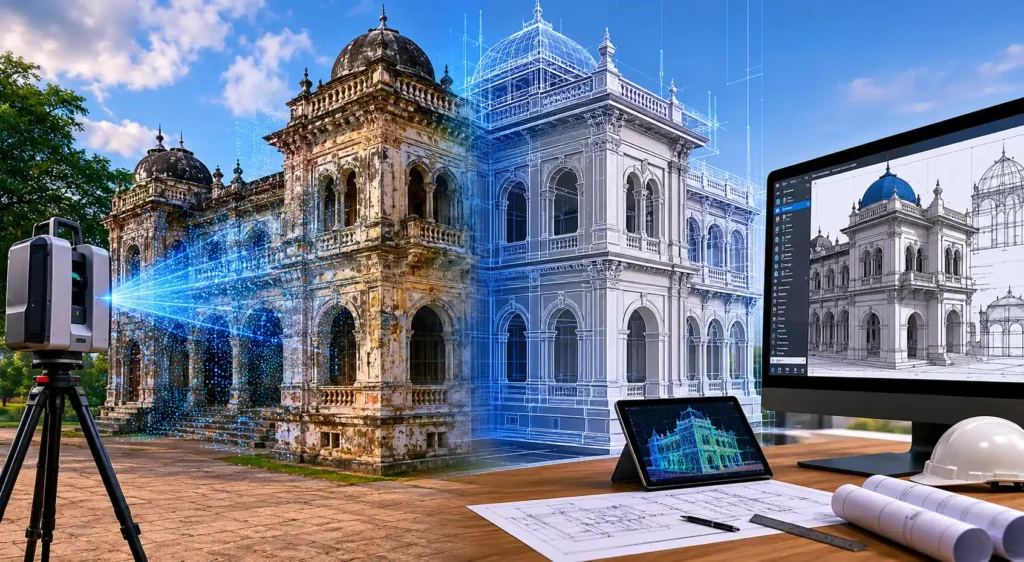
Historical and heritage buildings require careful restoration approaches that balance modernization with preservation. Scan to BIM services provide the accuracy, visualization, and digital intelligence necessary to restore these structures efficiently while maintaining their historical value.
At ProtoTech Solutions, we provide professional Scan to BIM services for heritage restoration, renovation, and conservation projects. Our dedicated team specializes in point cloud processing, BIM modeling, and restoration-focused workflows that help architects, engineers, and conservation teams restore historical buildings with confidence and precision.
Whether you are restoring a monument, heritage property, museum, temple, or historical structure, our Scan to BIM expertise can help you improve project accuracy, reduce restoration risks, and preserve architectural heritage for future generations.
Explore our Scan to BIM services and connect with our team to discuss your restoration project requirements.