
Architectural Drafting Standards in the USA: What You Must Know (AIA Guidelines)
Introduction
In the fast-paced world of U.S. construction, architectural drafting standards in the USA form the backbone of every successful project. Architectural drafting standards serve as the backbone of clear communication between architects, engineers, contractors, and regulatory authorities. In the United States, these standards are heavily influenced by the guidelines set by the American Institute of Architects (AIA), ensuring consistency, compliance, and professionalism across projects.
Whether you are designing a residential building or managing a large-scale commercial development, understanding these standards is essential. They not only streamline the design process but also help ensure that projects meet legal and safety requirements.
Overview of Architectural Drafting Standards in the USA
Architectural drafting standards refer to a set of rules and conventions used to create technical drawings and construction documents. These standards govern everything from line weights and symbols to sheet organization and annotations.
These standards bridge communication gaps between multidisciplinary teams. Imagine handing a contractor a drawing with ambiguous dimensions, errors skyrocket, budgets balloon, and timelines slip. By adhering to uniform practices, teams boost efficiency, slash rework by up to 30% (per industry studies), and meet legal requirements like those in the International Building Code (IBC).
In the U.S., these standards play a crucial role in:
- Ensuring uniformity across drawings
- Facilitating collaboration between multidisciplinary teams
- Reducing errors and misinterpretations
- Supporting compliance with building regulations
By following standardized drafting practices, professionals can communicate complex design ideas clearly and efficiently, minimizing costly mistakes during construction.
Understanding AIA Guidelines
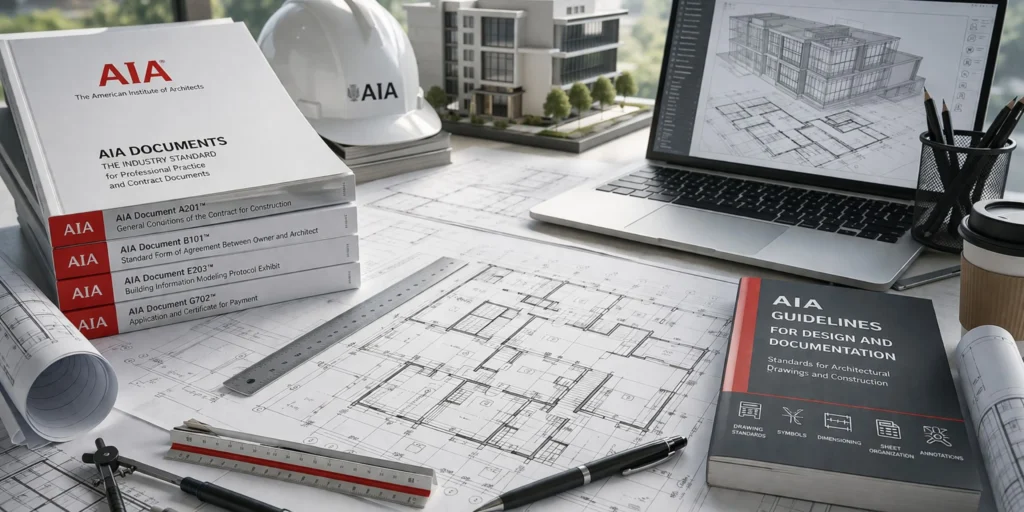
The AIA, a leading professional organization for architects, publishes authoritative AIA drafting guidelines through documents like the AIA G-series (e.g., G601 for drawing sets) and the Uniformat classification system. These set benchmarks for architectural drawing standards in the USA, promoting nationwide consistency.
AIA guidelines standardize drawing organization, sheet numbering (e.g., A-101 for architectural plans), symbols (like door swings), and annotations. They evolve with technology, integrating CAD and BIM workflows to make documentation scalable and collaborative.
AIA standards cover several critical aspects, including:
- Drawing organization and sheet numbering systems
- Standardized symbols and abbreviations
- Documentation formats for construction drawings
- Coordination between different disciplines
These guidelines help ensure that all stakeholders, from designers to contractors, interpret drawings consistently, reducing confusion and improving project outcomes.
Key AIA Drafting Standards to Follow
1. Drawing Scales and Units
Use imperial units (feet/inches) as primary in the USA, with scales like 1/4″ = 1′-0″ for floor plans or 1/8″ = 1′-0″ for site plans. Always include a graphic scale bar for flexibility during printing.
2. Line Types and Weights
AIA recommends six line weights: thick (0.7mm) for outlines, medium (0.5mm) for walls, and faint (0.18mm) for hidden features. Dashed lines denote concealed elements; centerlines use short dashes.
3. Title Blocks and Sheet Organization
Place title blocks in the lower right corner, including project name, sheet number (e.g., S101 for structural), revision history, and scale. Organize sheets logically: architectural (A), structural (S), mechanical (M).
4. Layering Standards (CAD/BIM)
Follow AIA’s CAD Layer Guidelines (e.g., A-WALL-FULL for full walls). Layers ensure discipline-specific visibility, vital for BIM models in tools like Revit.
5. Annotation and Dimensioning
Dimensions run horizontally/vertically, with continuous lines to points. Use clear text heights (1/8″ min) and leader lines without arrows touching text.
6. Symbols and Abbreviations
Standardize with AIA-approved legends: a north arrow with a graphic scale, door symbols (arc swings), and abbreviations like “CL” for centerline or “T.O.” for top of.
7. Construction Documentation Standards
Per AIA Document A201, include schedules, details, and notes for bid sets, ensuring constructability. Construction documents must be detailed and precise, covering: Plans, elevations, sections, Material specifications, and Construction details
These documents serve as the blueprint for execution, making accuracy essential.
Compliance with U.S. Building Codes and Regulations
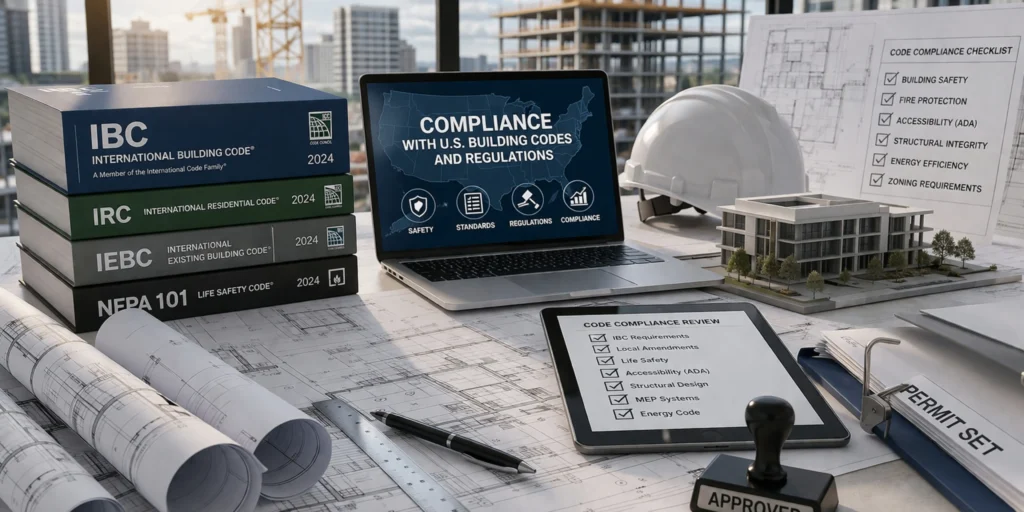
Architectural drafting standards must align with U.S. building codes and regulations to ensure safety and legality. The International Code Council, which publishes the International Building Code (IBC), is one of the most popular codes. Most states have adopted it with local modifications (such as California’s Title 24). These codes require ADA-compliant accessibility, fire ratings, and clear egress routes.
Key considerations include the following:
- Structural safety requirements
- Fire protection and life safety standards
- Accessibility compliance (ADA guidelines)
- Local and state-specific regulations
Failure to comply with these codes can result in project delays, penalties, or even legal issues. Non-compliance risks permit denials, fines up to $10,000 per violation, or stop-work orders. AIA standards embed these by requiring code-referenced notes, like seismic detailing in high-risk zones.
Benefits of Following AIA Drafting Standards
Adhering to AIA drafting standards offers numerous advantages:
- Improved Project Coordination: Ensures all stakeholders are aligned
- Reduced Errors: Minimizes design inconsistencies and construction mistakes
- Efficient Communication: Enhances clarity across teams
- Faster Approvals: Meets regulatory expectations more easily
- Professional Credibility: Demonstrates expertise and reliability
Ultimately, these standards contribute to smoother project execution and better outcomes.
Common Mistakes to Avoid
Even experienced professionals can overlook critical aspects of drafting standards. Common mistakes include:
- Inconsistent formats across sheets, confusing reviewers.
- Incorrect scaling, leading to built dimensions off by inches.
- Poor documentation, like missing revision clouds.
- Ignoring local building codes, such as Florida’s hurricane standards.
- Discipline silos, e.g., unaligned MEP and structural layers.
- Poorly labeled or missing annotations
- Lack of coordination between architectural and engineering drawings
Avoiding these errors is essential for maintaining quality and compliance.
Our Expertise in Architectural Services

ProtoTech Solutions we specialize providing architectural design and drafting services across the USA. With extensive experience in architectural services, we bring a deep understanding of AIA guidelines and U.S. building regulations to every project. We leverage advanced CAD tools like AutoCAD, SolidWorks, and BIM platforms (Revit and Navisworks) for precise 3D modeling and clash detection. Our approach combines technical precision with innovative design solutions to deliver high-quality results.
What Sets Us Apart:
- AIA-Compliant Drafting: We strictly follow industry standards to ensure accuracy and consistency
- Advanced Technology: Utilization of cutting-edge CAD and BIM tools for efficient workflows
- Code Compliance Expertise: Thorough knowledge of IBC and local regulations
- Quality Assurance: Rigorous checks to eliminate errors and ensure flawless documentation
- Client-Centric Approach: Tailored solutions that meet specific project requirements
By partnering with us, clients gain a reliable drafting team that prioritizes precision, compliance, and excellence.
Conclusion
Architectural drafting standards are essential for ensuring clarity, consistency, and compliance in construction projects across the United States. The guidelines established by the American Institute of Architects, combined with adherence to building codes like the International Building Code, create a solid foundation for successful project execution.
From improving communication to reducing costly errors, these standards play a critical role in every phase of design and construction. For professionals and clients alike, understanding and implementing AIA drafting standards is not just a best practice—it’s a necessity.
If you are looking to ensure accuracy, compliance, and efficiency in your architectural projects, working with experienced drafting experts can make all the difference.