Land Survey Drafting Costs: Pricing Models & Cost Factors

When planning a land development, construction, boundary, or surveying project, one question often comes up during budgeting:
How much does land survey drafting cost?
The short answer is that there is no universal rate.
Land survey drafting costs depend heavily on the type of survey, property size, drawing complexity, field data quality, required deliverables, CAD standards, turnaround time, and the amount of drafting and quality-control work involved.
As a general reference, outsourced land survey drafting may be priced per hour, per project, per sheet, or in some cases per square foot or acre. The right pricing method depends on how predictable the project scope is.
Important: All prices and cost ranges mentioned in this article are illustrative assumptions for general planning purposes only. Actual land survey drafting costs should be determined after reviewing the project scope, source data, drafting requirements, deliverables, and turnaround expectations.
Quick Answer: How Much Does Land Survey Drafting Cost?
For budgeting purposes, land survey drafting services may fall within the following assumed ranges:
| Pricing Model | Assumed Cost Range | Common Use Case |
| Per Hour | $20 – $60+ per hour | Ongoing or variable drafting requirements |
| Per Sheet | $100 – $500+ per sheet | Clearly defined drawing sets |
| Per Project | $300 – $3,000+ | Surveys with a defined scope and deliverables |
| Per Square Foot | Project-dependent | Certain site or development projects |
| Per Acre | Project-dependent | Larger parcels and land development surveys |
These figures are not standard market rates or quotations. A small boundary survey with clean field information may require significantly less drafting effort than a complex ALTA/NSPS survey or large topographic survey containing extensive features, utilities, contours, easements, and annotations.
What Is Land Survey Drafting?
Land survey drafting is the process of converting survey measurements, field observations, point data, sketches, existing records, and other source information into organized CAD drawings.
Depending on the project, survey drafting may involve:
- Importing and organizing survey point data
- Creating property and boundary linework
- Drafting existing site features
- Preparing contour and elevation information
- Adding bearings, distances, dimensions, and annotations
- Drafting easements and rights-of-way
- Organizing CAD layers, line types, blocks, and symbols
- Preparing title information, legends, notes, and sheet layouts
- Incorporating surveyor markups and revisions
- Following the client’s CAD standards and drawing templates
- Preparing final DWG and PDF deliverables
The drafting team generally works from information supplied by the surveyor or project team. Professional surveying judgments, boundary determinations, certifications, and other activities requiring licensure remain the responsibility of appropriately licensed professionals where required.
What Factors Affect Land Survey Drafting Costs?

Two properties of similar size can require very different amounts of drafting work. For this reason, property area alone is usually not enough to estimate survey drafting costs accurately.
1. Type of Land Survey
The type of survey is one of the strongest cost factors.
A straightforward boundary survey may primarily involve parcel geometry, dimensions, monuments, and relevant annotations. A detailed topographic or ALTA/NSPS survey may involve significantly more information.
Common projects include:
- Boundary surveys
- ALTA/NSPS land title surveys
- Topographic surveys
- As-built surveys
- Subdivision surveys
- Existing-condition surveys
- Construction surveys
- Site development surveys
- Utility and infrastructure surveys
More information generally means additional CAD production, checking, annotation, and revision time.
2. Property and Site Complexity
A five-acre open parcel and a five-acre developed commercial property should not automatically have the same drafting cost.
A developed site may contain:
- Buildings
- Parking areas
- Curbs and sidewalks
- Fences
- Retaining walls
- Drainage features
- Manholes and utilities
- Pavement markings
- Vegetation
- Elevation points
- Contours
- Easements
- Multiple adjoining parcels
The number and complexity of features can influence drafting effort more than the total site area.
3. Quality of the Input Data
Well-organized source data can make drafting considerably more efficient.
Drafting teams may receive:
- Survey point files
- CSV or TXT coordinate files
- Field sketches
- Existing DWG files
- PDF drawings
- Scanned plans
- Surveyor markups
- GIS references
- Photos
- Previous survey drawings
Clean point descriptions, consistent coding, organized reference files, and clearly documented requirements can reduce interpretation and rework.
Poorly organized or incomplete data may require additional coordination before drafting can proceed efficiently.
4. Drawing Detail and Deliverables
A basic CAD base drawing generally requires less production effort than a fully annotated survey drawing.
The scope may require:
- Existing conditions
- Property boundaries
- Bearings and distances
- Legal description references
- Easements
- Rights-of-way
- Contours
- Spot elevations
- Utility information
- Flood-related information
- Tables
- Legends
- Sheet layouts
- Client-specific blocks
- Layer standards
The greater the required level of detail, the more drafting and quality-control time may be necessary.
5. CAD Standards
Many land surveying companies have established CAD standards.
These may define:
- Layer names
- Colors
- Lineweights
- Linetypes
- Text styles
- Dimension styles
- Blocks and symbols
- Sheet sizes
- Title blocks
- Annotation standards
- File naming conventions
An outsourcing partner that can consistently follow these standards can become an extension of the internal production team rather than creating additional cleanup work.
6. Turnaround Time
Standard delivery schedules allow drafting teams to plan resources efficiently.
Urgent projects may require dedicated resources, extended working hours, or reprioritization of other assignments. Therefore, rush drafting can sometimes carry additional costs.
7. Number of Revisions
Pricing may also depend on how revisions are handled.
Minor corrections may be included within the original scope, while significant changes caused by additional field information, revised boundaries, expanded project scope, or new deliverables may require additional drafting hours.
A clear revision policy should therefore be established before work begins.
Land Survey Drafting Cost by Survey Type

The following table provides an illustrative comparison of how drafting complexity can differ.
| Survey Type | Typical Drafting Complexity | Assumed Drafting Cost |
| Basic Boundary Survey | Low–Medium | $300 – 800+ |
| Topographic Survey | Medium–High | $500 – 1,500+ |
| ALTA/NSPS Survey | High | $800 – 2,500+ |
| As-Built Survey | Medium | $400 – 1,200+ |
| Subdivision Survey | High | $1,000 – 3,000+ |
| Large Land Development Survey | High/Complex | Custom estimate |
*These ranges are hypothetical examples for general budgeting discussion. They are not fixed prices, quotations, or guaranteed industry averages. Actual pricing can vary substantially.
How Much Does Land Survey Drafting Cost Per Square Foot?
Clients sometimes ask whether survey drafting can be priced per square foot.
It can be used in certain situations, but cost per square foot is not always the most reliable pricing method for land survey drafting.
Consider two 100,000-square-foot sites.
Site A: Mostly open land with limited improvements and relatively simple topographic information.
Site B: A developed commercial site containing buildings, utilities, parking areas, drainage systems, sidewalks, curbs, landscaping, easements, and dense elevation data.
Both properties have the same area, but Site B could require substantially more drafting work.
Therefore, a per-square-foot rate makes the most sense when projects have relatively consistent scopes and levels of detail.
Per Square Foot vs. Per Acre Pricing
For larger parcels, acreage can sometimes be more intuitive than square footage.
One acre equals 43,560 square feet.
However, neither measurement tells the complete story.
A 50-acre rural parcel with limited improvements may be easier to draft than a 10-acre industrial site containing dense infrastructure and utility information.
For this reason, square footage or acreage should usually be considered alongside:
site complexity + survey type + required detail + source data + deliverables + turnaround time.
Example Land Survey Drafting Cost Calculation
Consider a hypothetical topographic survey requiring approximately 24 drafting hours.
If the assumed drafting rate is $35 per hour:
24 hours × $35/hour = $840 estimated drafting cost
Now suppose the project requires an additional eight hours for revised field data and drawing updates:
8 hours × $35/hour = $280
The total hypothetical drafting cost becomes:
$840 + $280 = $1,120
This simple example illustrates why clearly defining scope, input data, revision expectations, and final deliverables can improve cost predictability.
What Information Is Needed for an Accurate Drafting Quote?
A reliable estimate should be based on actual project information rather than property area alone.
Before requesting a quote, consider providing:
- Survey type — boundary, ALTA/NSPS, topographic, as-built, subdivision, etc.
- Property size — square footage or acreage.
- Available source data — point files, field notes, existing CAD, PDFs, markups, or reference plans.
- Required deliverables — DWG, PDF, sheets, base drawings, or other formats.
- CAD standards — templates, layers, blocks, text styles, and title blocks.
- Required level of detail — boundaries, contours, utilities, easements, improvements, annotations, and related information.
- Expected turnaround — standard or expedited.
- Revision requirements — anticipated review cycles and updates.
Providing these details allows the drafting provider to estimate the actual production effort more accurately.
Is Outsourcing Land Survey Drafting Cost-Effective?
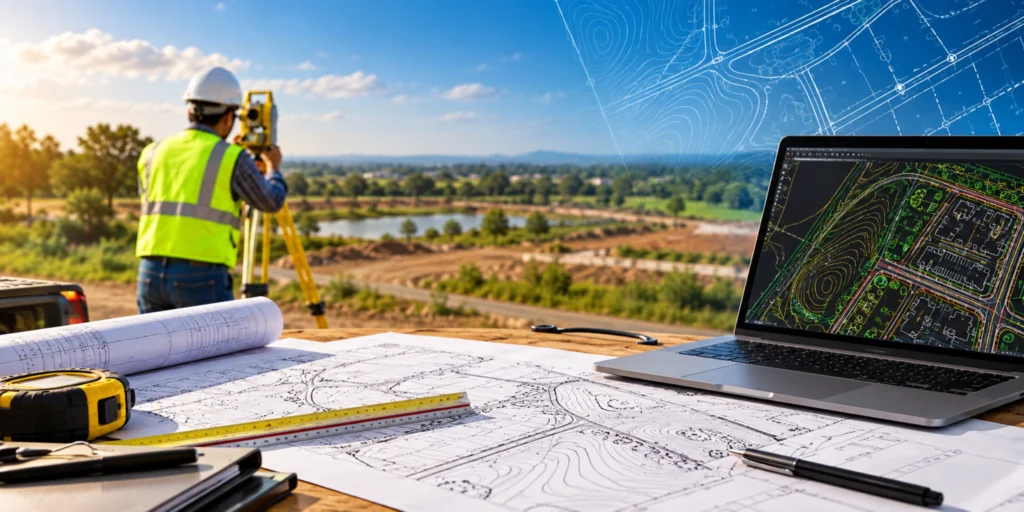
For some survey and land development organizations, outsourcing can provide an alternative to increasing permanent internal drafting capacity.
The potential benefit is not simply a lower hourly rate. It is the ability to add production capacity when workload increases.
For example, outsourcing can help when:
- Field crews are producing data faster than the internal CAD team can process it.
- A backlog of survey drawings is developing.
- Several projects reach the drafting stage simultaneously.
- Additional resources are needed for a short-term project.
- Internal surveyors need to spend more time on technical review and project coordination.
- The company wants access to additional CAD resources without immediately expanding permanent staffing.
The actual cost benefit should be evaluated against internal labor costs, management effort, software and infrastructure costs, training, quality requirements, and expected utilization.
What Should You Look for in a Land Survey Drafting Partner?
Price should be only one part of the evaluation.
Land survey drawings require accuracy, consistency, and disciplined CAD production. An outsourcing provider should be able to understand technical requirements and work within your existing process.
Consider evaluating:
- Experience with survey and civil CAD drafting
- Ability to follow your CAD standards
- Familiarity with common survey drawing types
- Data security practices
- Quality-control procedures
- Communication and revision workflows
- Ability to scale resources
- Turnaround capability
- Supported CAD software and file formats
For recurring work, consistency can be particularly important. A drafting team that becomes familiar with your standards, templates, and project expectations may require less coordination over time.
How Can You Reduce Land Survey Drafting Costs?
Reducing drafting costs does not necessarily mean finding the lowest hourly rate. Improving the production workflow can often create more sustainable savings.
You can help improve drafting efficiency by providing complete and organized source data, standardized CAD templates, clear layer and annotation standards, consistent field codes, example completed drawings, well-defined project scopes, and consolidated review comments.
For ongoing projects, establishing a repeatable drafting process can also reduce unnecessary communication and revisions.
Final Thoughts
There is no universal answer to how much land survey drafting costs.
Pricing depends on much more than property size. Survey type, site complexity, field data, CAD standards, drawing detail, turnaround expectations, and revision requirements can all influence the final drafting effort.
That is why the most useful way to estimate a project is to review the actual source information and clearly define the expected deliverables.
For land survey companies and construction development teams managing ongoing workloads, outsourcing can also provide additional drafting capacity when internal resources are stretched or project demand changes.
How ProtoTech Solutions Can Help
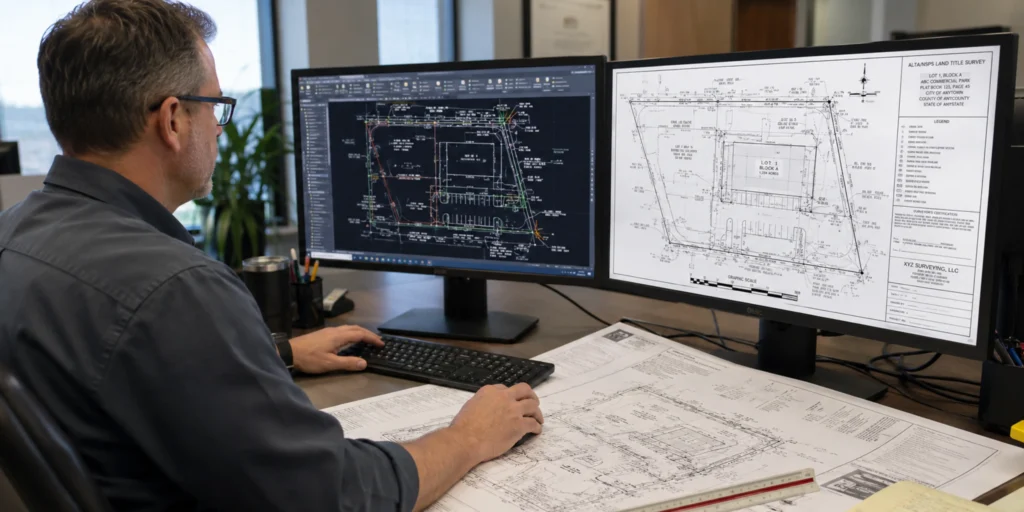
ProtoTech Solutions provides CAD design and drafting support for businesses that need additional technical production capacity for ongoing and upcoming projects.
For land survey drafting requirements, our team can work with your project data, drawings, markups, and CAD standards to support the production of accurate, organized drawings. Whether you need assistance with a single project, an existing drafting backlog, or ongoing CAD support, we can adapt the engagement to your project requirements.
Connect with our experts to discuss your land survey drafting requirements and find the right solution at competitive pricing.