How 3D Jewelry Configurators Increase Sales & Reduce Returns
Introduction
According to the market survey, in 2025, the global jewelry market was valued at USD 381.54 billion and is projected to reach USD 578.45 billion by 2033, reflecting a CAGR of 5.5% over the forecast period. Key factors driving this growth include higher disposable incomes, evolving fashion trends, and growing consumer interest in premium and customized jewelry.
At the same time, the way consumers shop for jewelry has evolved significantly. Customers are no longer satisfied with browsing static images or reading product descriptions. Today’s customers expect a more immersive, interactive experience that helps them better understand and connect with the product before making a purchase. This shift is particularly critical in the jewelry industry, where buying decisions are often emotional, high-value, and deeply personal.
In response to these changing expectations, 3D jewelry configurators are emerging as a powerful solution to meet these expectations. These tools enable customers to visualize, customize, and interact with jewelry designs in real time, fostering greater confidence in their purchasing decisions. For businesses, this translates into improved conversion rates, enhanced customer satisfaction, and reduced return rates.
In this article, we will explore how 3D jewelry configurators can elevate e-commerce performance and why they are becoming an essential investment for modern jewelry brands.
What Is a 3D Jewelry Configurator?
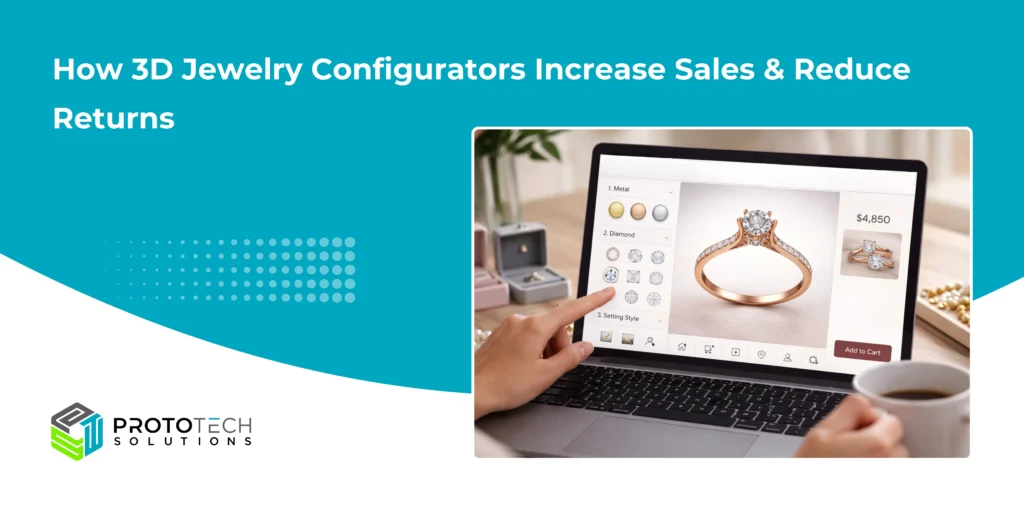
At its core, a 3D jewelry configurator is an interactive digital tool that brings your products to life. Instead of relying on imagination, customers can see exactly how a piece of jewelry will look as they customize it.
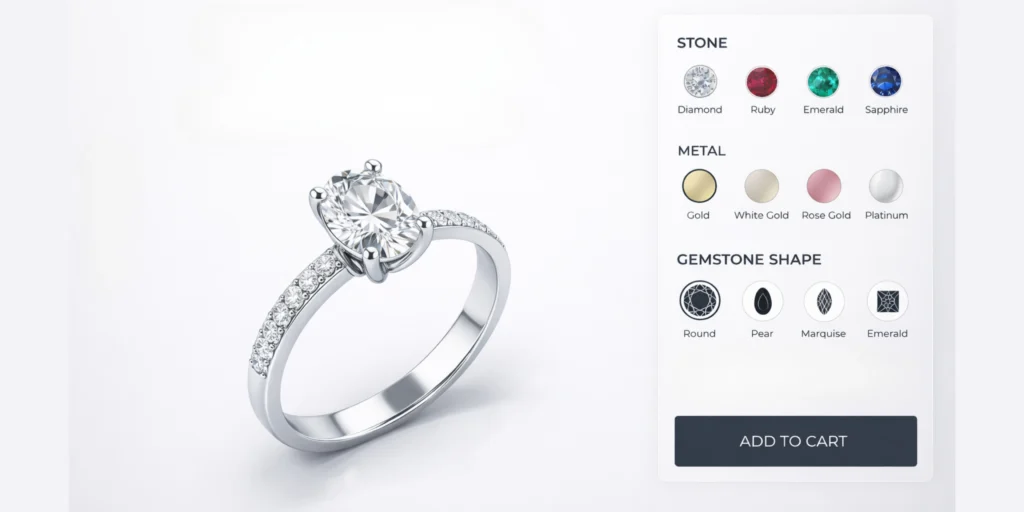
For example, a customer shopping for an engagement ring can change the metal from white gold to platinum, adjust the diamond shape, or experiment with different settings, all while watching the design update instantly on their screen. They can rotate the product, zoom in to inspect fine details, and explore how light interacts with the materials.
This level of interaction bridges the gap between online and in-store experiences. It recreates the feeling of holding a piece of jewelry in your hand, something traditional eCommerce has always struggled to achieve.
Why Traditional Jewelry eCommerce Falls Short
To fully appreciate the value of a 3D jewelry configurator, it’s important to understand the limitations of conventional online jewelry shopping.
Most jewelry websites still rely heavily on static images and basic product descriptions. While these can showcase a product to some extent, they fail to communicate the full depth, brilliance, and craftsmanship of a piece. Jewelry is inherently visual and tactile, and flat images simply cannot capture its true essence.
1. Limited Visualization
Static images don’t fully capture details like shine, depth, or scale.
2. Uncertainty in Custom Orders
Customers often hesitate when buying customized jewelry because they can’t visualize the final product.
3. Higher Return Rates
Mismatched expectations lead to dissatisfaction and, ultimately, returns.
4. Lower Engagement
Standard product pages fail to keep users engaged for long.
Even when customers go ahead and buy, the gap between expectations and reality can lead to disappointment. This is one of the primary reasons why return rates in jewelry eCommerce can be high, especially for customized products.
How a 3D Jewelry Configurator Increases Sales
1. Enhances Customer Confidence
When customers can rotate, zoom, and customize a product in real time, they feel more confident in their purchase decisions.
- They know exactly what they’re getting
- They can experiment with different options
- They feel in control
Result: Higher trust leads to higher conversions.
2. Creates a Personalized Shopping Experience
Modern consumers value personalization. A 3D jewelry configurator allows customers to design jewelry that reflects their style.
For example:
- Choosing a diamond cut
- Selecting metal type
- Adjusting size and settings
This level of customization transforms shopping into an experience, not just a transaction.
Result: Customers are more likely to buy and spend more.
3. Increases Average Order Value (AOV)
When users interact with a configurator, they often explore premium options:
- Upgrading to higher-quality materials
- Adding extra features
- Choosing larger or better gemstones
Because they can visually compare options, customers are more comfortable selecting higher-priced variations.
Result: Increased revenue per order.
4. Improves Engagement and Time on Site
Interactive tools naturally keep users engaged longer than static pages.
A 3D jewelry configurator encourages users to:
- Experiment with designs
- Compare variations
- Spend more time exploring
This increased engagement signals quality to search engines and improves SEO performance.
Result: Better user experience and improved rankings.
5. Reduces Purchase Friction
One of the biggest barriers in online jewelry sales is hesitation.
A 3D configurator removes doubts by answering key questions:
- How will it look from different angles?
- Will the gemstone match the setting?
- Does the size feel right?
When customers get these answers instantly, they are more likely to complete the purchase.
Result: Lower cart abandonment rates.
Additional Business Benefits
1. Competitive Advantage
Offering a 3D jewelry configurator sets your brand apart from competitors using traditional product displays.
2. Scalability
You can showcase multiple variations without needing physical inventory for each.
3. Data Insights
Track customer preferences and popular combinations to optimize your offerings.
Best Practices for Implementing a 3D Jewelry Configurator
To get the most out of a 3D jewelry configurator, it’s essential to focus on the user experience. The tool should feel intuitive and easy to use, even for customers who are not tech-savvy. A clean interface, smooth navigation, and fast loading times are crucial. If you’re considering adopting this technology, here are the key best practices to follow:
1. Focus on User Experience
Keep the interface clean and easy to navigate. Avoid overwhelming users with too many options at once, and guide them step-by-step through the customization process.
2. Ensure High-Quality Rendering
Realistic and high-resolution 3D visuals are essential. The closer the product looks to real-life jewelry, the higher the customer trust and confidence.
3. Optimize for Mobile
A significant portion of users shop on mobile devices. Ensure that the configurator performs smoothly across all screen sizes without compromising quality or speed.
4. Integrate CPQ (Configure, Price, Quote) Functionality
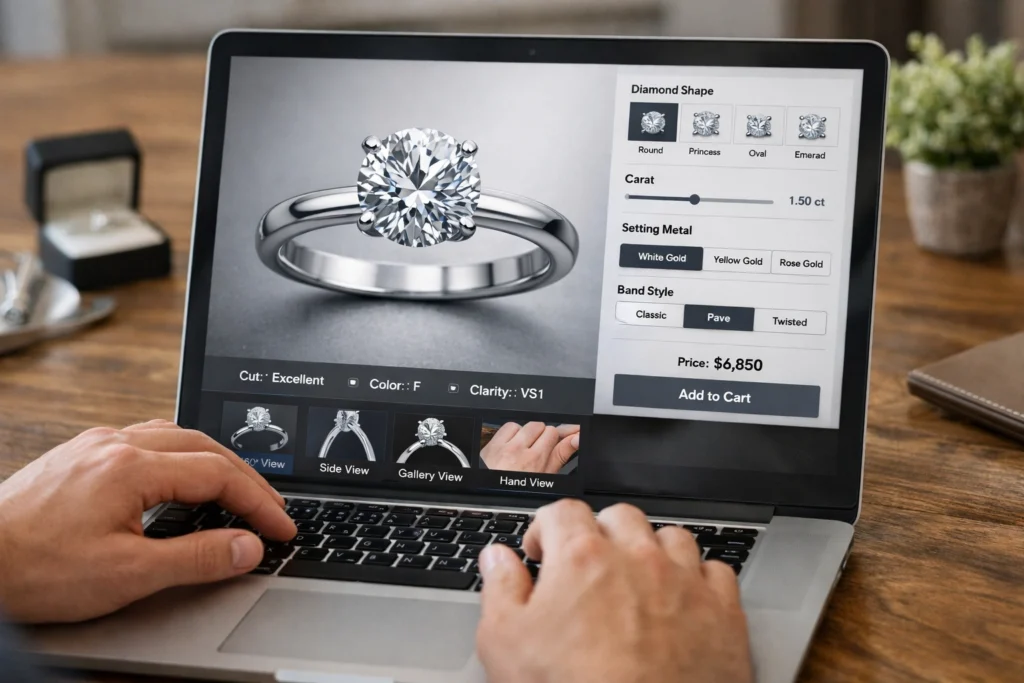
Enable real-time pricing as customers customize products. This ensures accurate quotes, reduces errors, and speeds up the buying process.
- Automatically update pricing in real time as customers customize products
- Handle complex pricing rules based on materials, gemstones, size, and design variations
- Provide instant quotes without manual intervention
- Reduce pricing errors and inconsistencies
- Accelerate the buying process by eliminating delays in price calculation
5. Enable Seamless eCommerce Integration
Ensure the configurator connects directly with your cart, checkout, and backend systems so customers can easily complete their purchase without friction.
6. Provide Guided Customization
Offer suggestions, presets, or recommended combinations to help users make decisions faster, especially if they are not familiar with jewelry customization.
Is It the Right Time to Invest?
For many jewelry businesses, the question is no longer whether to adopt a 3D jewelry configurator, but when. As customer expectations continue to rise, brands that fail to offer interactive and personalized experiences risk falling behind.
If your business focuses on customization, high-value products, or direct-to-consumer sales, the benefits can be particularly significant. A well-implemented configurator can deliver a strong return on investment by increasing conversions, reducing returns, and enhancing customer loyalty.
Final Thoughts
The jewelry industry is built on beauty, emotion, and trust. A 3D jewelry configurator brings all of these elements into the digital space, creating an experience that feels both engaging and reliable. By giving customers the ability to see and design their jewelry in real time, you remove uncertainty and replace it with confidence.
As e-commerce continues to evolve, tools like 3D configurators are setting a new standard for how jewelry is sold online. Businesses that embrace this technology today will be better positioned to meet customer expectations and achieve sustainable growth in the future.
If you’re looking to elevate your online jewelry experience and drive measurable results, investing in a 3D configurator could be one of the smartest decisions you make.