Construction Industry Market Outlook for 2026
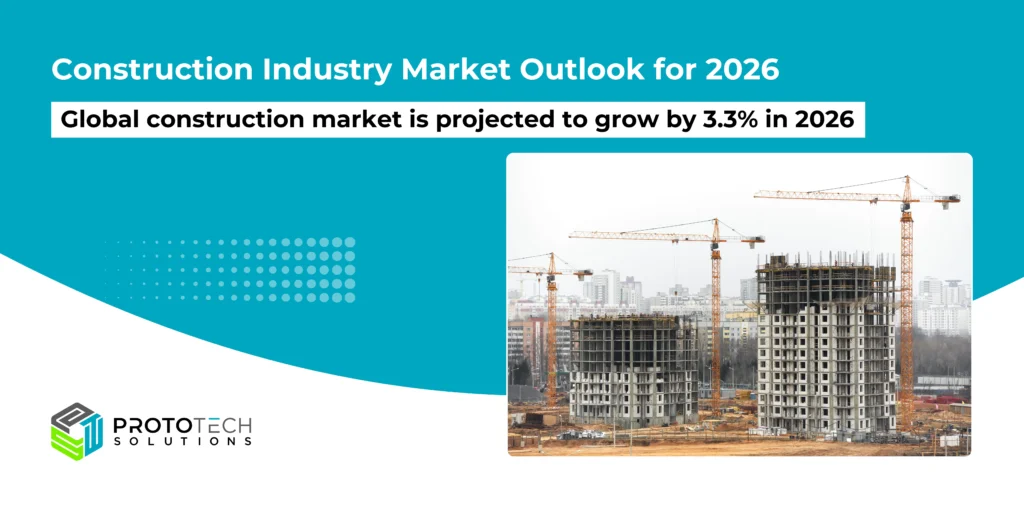
The global construction market is projected to grow by 3.3% in 2026 (after ~2.3% in 2025), driven by innovation and infrastructure demands amid economic headwinds. This modest expansion reflects resilience in sectors like institutional facilities, expected to rise 3.8%, while total U.S. construction spending could reach $1.26 trillion.
Building Information Modeling (BIM) streamlines project planning, reducing costs and delays through AI integration. Modular prefabrication cuts timelines by up to 60%, with the market expanding from $104 billion in 2024 to $140.8 billion by 2029, enabling faster, waste-minimizing builds. 3D printing and robotics further transform workflows. Robotic bricklayers boost speed by 400%, while drones enhance accuracy by 61%, pushing projects to unprecedented efficiency.
Key Market Trends & Highlights
Key market trends in the construction industry for 2026 highlight technology integration, sustainability, and sector-specific growth amid labor challenges.
Sector Growth Highlights
Infrastructure leads with 4.1% growth from federal funding and rehabilitation projects. Data centers surge 8.2%, fueled by AI and cloud demands, while healthcare rises 3.8% due to modernization. Overall, U.S. spending nears $1.26 trillion, with institutional sectors showing resilience.
Technology-Driven Trends
AI enhances estimation accuracy to 95% and optimizes supply chains, cutting waste by 30%. BIM, digital twins, AR/VR, drones, and robotics address labor shortages, boosting productivity and reducing defects by up to 73%. Modular/prefab construction expands the market to $140.8 billion by 2029, slashing timelines by 60%.
Sustainability Focus
Low-carbon materials and procurement mandates drive adoption, with wood facades up 25% and carbon-heavy options declining. Smart cities integrate AI traffic, EV infrastructure, and microgrids for lifecycle management. Prefab and bio-based materials align with regulations, minimizing emissions and waste.
Construction Market Drivers
Construction market drivers for 2026 center on infrastructure investments, technology demands, and sustainability mandates amid labor shortages.
Infrastructure Funding
Federal programs like the Infrastructure Investment and Jobs Act (IIJA) propel 4.1% growth in roads, bridges, and water systems through billions in rehabilitation funding. Renewable energy surges 6.5% via IRA incentives for clean-energy transitions.
Technology and Sector Demand
Data centers expand 8.2% due to AI, cloud computing, and smart-city needs. Advanced manufacturing and semiconductors drive reshoring, boosting industrial facilities. Healthcare modernization grows 3.8%, addressing aging populations and compliance.
Sustainability and Economic Factors
Environmental, Social, and Governance (ESG) requirements favor low-carbon materials and resilient designs, with adaptive reuse rising in high-vacancy areas. Easing interest rates and fiscal stimulus foster optimism despite costs and labor gaps. The demand for environmentally friendly materials and energy-efficient designs is transforming construction practices. The global construction industry is shifting towards more sustainable practices, with many projects aiming for certifications like LEED or BREEAM.
How Trending Technology Takes Building to the Next Level
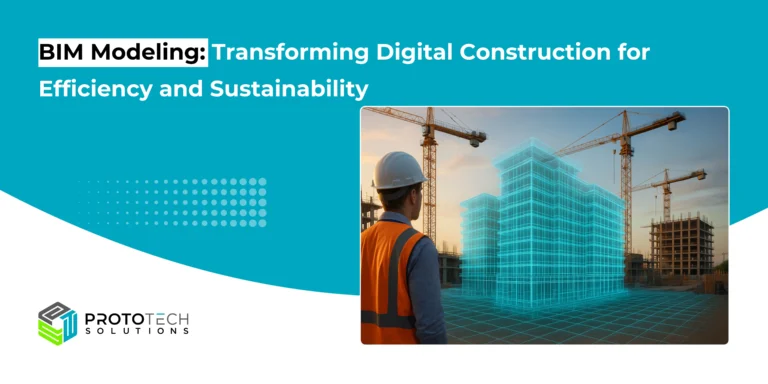
Trending technologies in 2026 are revolutionizing the construction industry through AI integration, advanced BIM, 3D printing, and sustainable materials, enabling faster, greener, and more efficient building processes. AI-integrated BIM and digital twins predict energy performance, maintenance needs, and real-time building behavior, closing the gap between design and operations.
1) AI-assisted planning, estimating, and risk control
AI is increasingly used to:
- Speed up quantity takeoffs and early budgets
- Flag scope gaps and coordination risks
- Optimize schedules using historical project patterns
2) BIM to VDC: from 3D models to buildable intelligence
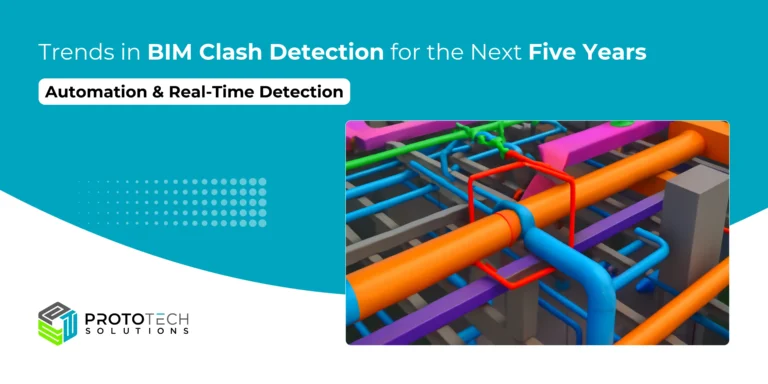
BIM is no longer just a design deliverable. In 2026-ready organizations, BIM becomes the backbone for:
- Clash detection and constructability
- 4D sequencing (model + schedule)
- 5D cost integration (model + estimate)
- Shop drawings and fabrication-ready outputs
3) Digital twins + IoT: visibility beyond handover
Digital twins are evolving from buzzword to operational advantage, especially for owners who care about lifecycle performance. Some firms report 10–20% operating cost reductions using digital twins in construction and operations through better monitoring and predictive maintenance. For contractors, that same connected data helps validate installation, track commissioning readiness, and reduce rework.
4) Robotics, automation, and safer productivity
Robotics adoption is still uneven, but the use cases are getting clearer: repetitive tasks, hazardous environments, and precision workflows. Industry trend coverage for 2026 continues to spotlight robotics and embedded sensing as adoption accelerators.
5) Immersive and Monitoring Tech
AR/VR/XR visualizes BIM data on-site, accelerating issue identification by up to 41.7% and enabling remote guidance. Drones and IoT provide real-time site monitoring for safety, equipment tracking, and structural integrity. 5G enhances data sharing for large-scale drawings and collaboration.
Why Outsourcing Firms Matter More in 2026 (and How They Cut Overhead)
As delivery gets more digital, construction companies face a tough math problem:
- Hiring and retaining specialized talent (BIM/VDC, detailing, estimators, and schedulers) is expensive.
- Workloads are volatile, one month overloaded, the next month quiet.
- Tools, licenses, workstations, and management overhead add up fast.
That’s where outsourcing partners, especially engineering and production teams, fit strategically.
The overhead cost problem outsourcing solves
Outsourcing can reduce or eliminate costs tied to:
- Full-time salaries, benefits, recruiting, and training
- Software licensing and high-end workstations
- Scaling managers to handle fluctuating workloads.
Many providers position outsourcing specifically as a way to reduce in-house infrastructure and staffing burdens.
And when firms offshore certain engineering/production tasks, reported savings can be significant; some services cite ~30% to 60% cost savings depending on scope and complexity (with quality controls in place).
What to outsource (high impact, low drama)
For many contractors and AEC firms, the best ROI comes from outsourcing repeatable, process-driven outputs, such as
- Quantity takeoffs and estimating support
- BIM modeling (LOD-based), clash reports, and coordination packs
- Shop drawings, fabrication drawings, and as-builts
- Permit sets support and drafting backlogs
- Construction documentation
ProtoTech Solutions is a leading CAD services and BIM outsourcing company, trusted by global clients for delivering accurate, scalable, and cost-effective design solutions. We deliver 2D CAD drafting, 3D modeling, and comprehensive BIM services that support architecture, engineering, construction, and manufacturing projects.
Whether you need short-term production support or a long-term outsourcing partner, ProtoTech adapts to your workflow, becoming an extension of your in-house team. From concept drawings to construction documentation and BIM coordination, ProtoTech Solutions ensures your design processes remain efficient, reliable, and future-ready.
Ready to Optimize Your Construction Design Workflows? Talk to Our CAD & BIM Experts