Why Three.js Is the Best Choice for 3D Data Visualization
What is the Difference Between JavaScript and Three.js?
Three.js abstracts the low-level WebGL API, enabling developers to build GPU-accelerated 3D scenes with objects like meshes, particles, geometries (e.g., cubes, spheres), materials, lights, cameras, and post-processing effects such as bloom or depth of field. It supports import/export formats including glTF, OBJ, and JSON, along with interactive controls like OrbitControls for user navigation.
JavaScript is a general-purpose programming language used for web development, while Three.js is a specialized JavaScript library built on top of WebGL for creating and rendering 3D graphics in browsers.
JavaScript handles diverse tasks like DOM manipulation, event handling, server-side logic with Node.js, and 2D animations across client and server environments. Three.js narrows its focus to 3D rendering, abstracting WebGL complexities into high-level APIs for scenes, cameras, meshes, lights, materials, and animations.
Technical Differences
| Aspect | JavaScript | Three.js |
| Core Nature | Programming language | JavaScript library/API |
| Primary Use | General web interactivity, logic | 3D graphics, scenes, GPU-accelerated rendering |
| Dependencies | None (native in browsers) | Relies on WebGL and JavaScript |
| Learning Curve | Broad fundamentals | Requires JS knowledge plus 3D concepts |
| Performance | CPU-focused for logic | GPU-optimized for real-time 3D |
Development Speed Benefits of Three.js
Three.js builds on WebGL by providing a user-friendly API with built-in objects like meshes, cameras, lights, and materials, reducing the need to write low-level shaders and manage GPU buffers manually. Raw WebGL demands expertise in graphics programming, including vertex and fragment shaders, for every rendering task, which slows prototyping. This abstraction layer in Three.js cuts development time significantly, allowing focus on creative features rather than boilerplate code.
Speed Benefits:
- Three.js enables complex 3D scenes with minimal lines of code, ideal for rapid iteration in web projects.
- Pre-built utilities handle scene management, animations, and loaders, bypassing WebGL’s manual setup.
- Extensive examples and community resources accelerate onboarding for developers new to 3D web graphics.
Why Choose Three.js for 3D Data Visualization?

If you’re working in the web ecosystem and looking to bring real-time, interactive 3D data visualizations to the browser, Three.js stands out as the top JavaScript library choice for developers. Built on top of WebGL, Three.js abstracts the complex WebGL API into a user-friendly library that allows rapid creation and rendering of 3D scenes, models, lights, and animations, all running efficiently in modern browsers without plugins. This ease of use, combined with powerful features, makes Three.js ideal for delivering interactive, performant 3D visualizations tailored to engineering and CAD workflows.
Below is a developer-focused breakdown of why Three.js continues to dominate when it comes to building rich, interactive, 3D data-driven experiences.
1. Simplifies Complex 3D Graphics Programming
Three.js substantially reduces the learning curve associated with raw WebGL programming. Instead of dealing with low-level shaders and rendering pipelines, developers get access to a comprehensive set of objects and helpers to build scenes, cameras, lighting, materials, and meshes with minimal boilerplate code. This allows engineers and CAD visualization developers to focus on domain-specific logic rather than graphics engine intricacies.
2. Cross-Platform and Browser Support
One major advantage of Three.js is its robust cross-browser compatibility and mobile support. As a widely adopted open-source project, Three.js ensures consistent rendering performance across all modern browsers and devices. This means your 3D data visualizations and CAD product viewers will reach a broader audience without compatibility worries, whether accessed on desktop or mobile platforms.
3. Rich Ecosystem and Strong Community
Because of its popularity, Three.js boasts an extensive community and ecosystem of plugins, loaders for various 3D formats, and example codes. Developers can find ready-made solutions and tutorials to accelerate projects and customize their 3D visualizations to fit complex engineering data sets. This active support reduces development risks and speeds up innovation cycles.
4. Performance and Flexibility for Engineering Applications
Three.js is optimized to efficiently render large 3D models and complex scenes without compromising performance. It supports advanced rendering techniques, real-time animations, and user interactivity, all critical for detailed CAD visualization, product configurators, and engineering platforms. Its flexibility allows easy integration with other front-end frameworks and APIs for data-driven and configurable 3D applications.
5. Seamless Integration With 3D Data Formats
3D visualization often involves imported CAD models, IoT data, or simulation outputs. Three.js supports modern formats like
- glTF / GLB (industry standard)
- OBJ, STL, PLY, FBX
- Custom BufferGeometry pipelines
If your workflow includes CAD or engineering data pipelines, Three.js can easily handle the loading, compression, and rendering of those assets.
Conclusion
Three.js stands out because it gives developers the best of both worlds: performance and simplicity. Whether you’re visualizing live sensor data, rendering CAD assemblies, or building interactive product configurators, it empowers you to deliver rich 3D experiences with clean and maintainable code.
Developers use plain JavaScript for app structure and logic, then import Three.js to add 3D elements like geometries (cubes, spheres) and controls without plugins. Three.js extends JavaScript’s capabilities for engineering visualizations, games, and CAD viewers, but demands solid JS proficiency first.
Your Partner for Advanced Three.js Development
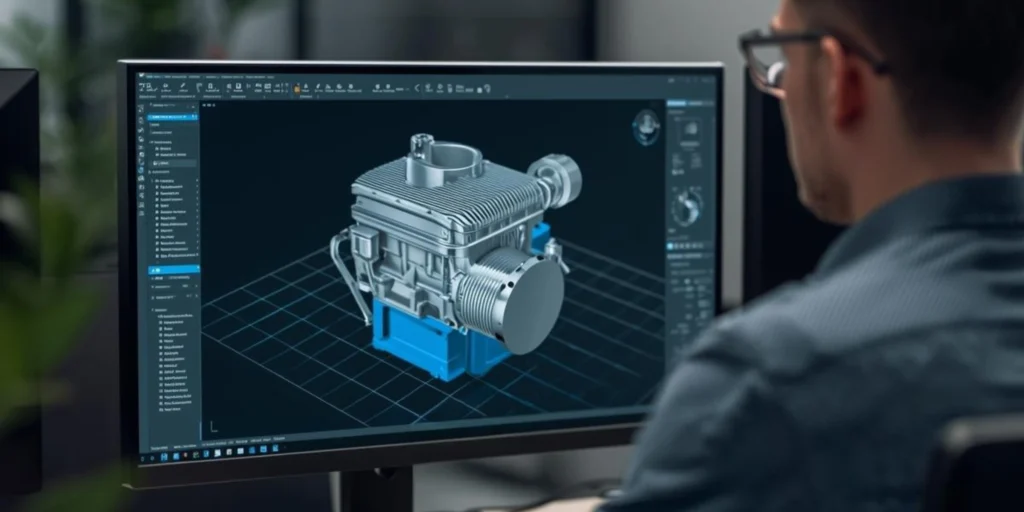
If you or your development team are looking to implement Three.js in complex engineering or CAD-focused projects, partnering with dedicated Three.js experts can dramatically accelerate your progress. Skilled developers ensure proper architecture, optimized rendering, scalable code, and seamless integration, helping your 3D visualization projects reach the next level.
If you haven’t been able to find experienced or highly skilled Three.js developers, we are here to help you. At ProtoTech Solutions, we use over 15 years of expertise in Three.js and web-based 3D technologies, delivering cutting-edge visualization solutions to clients across the globe.
Our dedicated team of Three.js developers specializes in building high-performance 3D web applications tailored for engineering, manufacturing, and CAD-intensive industries. Whether you need immersive product configurators, BIM and engineering model viewers, or advanced data visualization tools, our experts architect and implement solutions that are fast, scalable, and visually precise.
We develop custom 3D CAD product viewers, web-based engineering platforms, and 3D data visualization applications that leverage the full potential of Three.js. Our experience also includes 3D model configurators with CPQ integration, enabling interactive, customizable product experiences right inside the browser.
Talk to a Three.js expert today and bring your 3D vision to life with ProtoTech Solutions.