
Why Geometry Healing Is Critical for SaaS-Based FEA Applications

Introduction
Developing a SaaS-based simulation platform requires more than just a solver engine. The platform must be capable of handling CAD data efficiently, visualizing complex assemblies, and preparing geometry for simulation workflows.
At ProtoTech Solutions, we help engineering software companies develop robust solutions across multiple areas of CAD and simulation technology. Our experience includes building advanced cloud-based CAD, visualization, and simulation platforms that allow users to load and interact with large engineering models directly within a web browser.
Many of these platforms are now moving toward SaaS-based Finite Element Analysis (FEA), where users upload CAD models directly into the cloud and perform simulations without installing complex desktop tools.
However, one challenge consistently appears in these platforms: geometry quality. CAD models coming from different systems often contain topological and geometrical issues that prevent reliable meshing and simulation. If these problems are not addressed before simulation, the results may be inaccurate, or the simulation process may fail entirely.
This is where geometry healing becomes essential. In modern SaaS-based FEA applications, geometry healing ensures that imported CAD models are clean, consistent, and ready for simulation workflows.
The Challenge of Using Raw CAD Data in Simulation
Most FEA applications rely on CAD geometry created in various design systems such as PTC Creo, Parasolid, or ACIS. When these models are exported and transferred across systems, they frequently contain structural inconsistencies.
Common geometry problems include:
- Small gaps between surfaces
- Overlapping or intersecting faces
- Missing edges or incorrect topology
- Tiny features that complicate meshing
- Invalid solid bodies or open shells
These issues may not always be visible during visualization, but they can cause major failures during mesh generation, which is a critical step in finite element simulation.
For SaaS-based platforms that process CAD models automatically in the cloud, handling these issues becomes even more important.
ACIS vs Parasolid in Geometry Processing
ACIS (Alan, Charles, Ian’s System) and Parasolid are two widely used geometric modeling kernels that power many CAD applications. Both provide core capabilities such as solid modeling, surface operations, and topology management.
For engineering platforms that require reliable geometry processing, choosing the right kernel plays an important role in supporting operations such as geometry healing, defeaturing, and model editing.
What Is Geometry Healing?
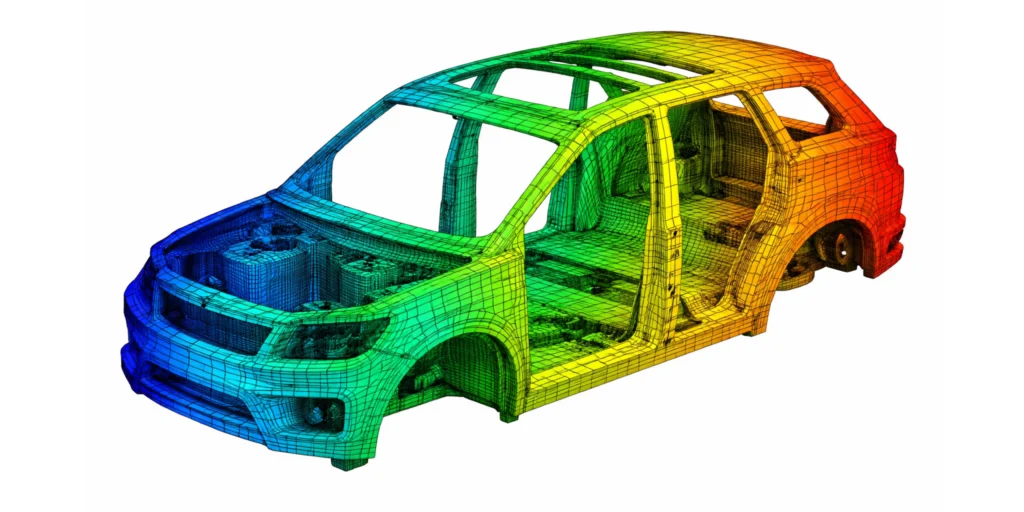
Geometry healing is the process of detecting and repairing defects in CAD models so that they become mathematically consistent and suitable for downstream operations such as meshing and simulation.
The goal of geometry healing is to ensure that the model:
- Forms a valid solid body
- Contains consistent topology
- Has properly connected surfaces and edges
- Does not contain invalid or redundant geometry
Typical geometry healing operations include:
- Gap closing between adjacent surfaces
- Edge stitching to form watertight solids
- Face merging to simplify topology
- Removal of redundant entities
- Surface correction to ensure continuity
When these operations are performed correctly, the CAD model becomes stable for further processing, such as defeaturing and meshing.
Why Geometry Healing Is Essential for SaaS-Based FEA Platforms
1. Ensures Reliable Mesh Generation
FEA simulations depend on high-quality meshes. If the geometry contains gaps or inconsistent topology, the meshing algorithm may fail or produce distorted elements.
Geometry healing ensures that the model is watertight and structurally valid, enabling reliable mesh generation.
2. Enables Automated Cloud Workflows
In a SaaS environment, users upload CAD models directly to the platform. These models may come from multiple CAD systems and may not follow consistent modeling standards.
Geometry healing allows the system to automatically detect and repair issues, making the platform more robust and user-friendly.
3. Improves Simulation Accuracy
Defective geometry can lead to:
- Incorrect mesh topology
- Unstable simulation results
- Unrealistic stress or deformation calculations
By repairing geometry before meshing, healing helps ensure more accurate and reliable simulation results.
4. Simplifies Complex CAD Assemblies
Many CAD models used for simulation contain unnecessary design details such as small holes, fillets, or cosmetic features. While useful in design, these features are often irrelevant for simulation.
Geometry healing combined with defeaturing techniques helps simplify the model while maintaining its physical integrity.
Geometry Healing in a Browser-Based Engineering Platform
Developing a SaaS-based simulation platform introduces additional technical challenges. The system must handle geometry operations efficiently while running in the cloud and interacting through a browser interface.
Typical requirements include:
- Importing CAD assemblies from multiple formats
- Detecting topology errors automatically
- Providing semi-automatic healing tools
- Supporting model editing operations such as merging or deleting entities
- Preparing models for meshing and simulation pipelines
These capabilities require robust CAD kernels, geometry processing algorithms, and efficient cloud architecture.
How ProtoTech Solutions Helps Build Robust Geometry Processing Workflows
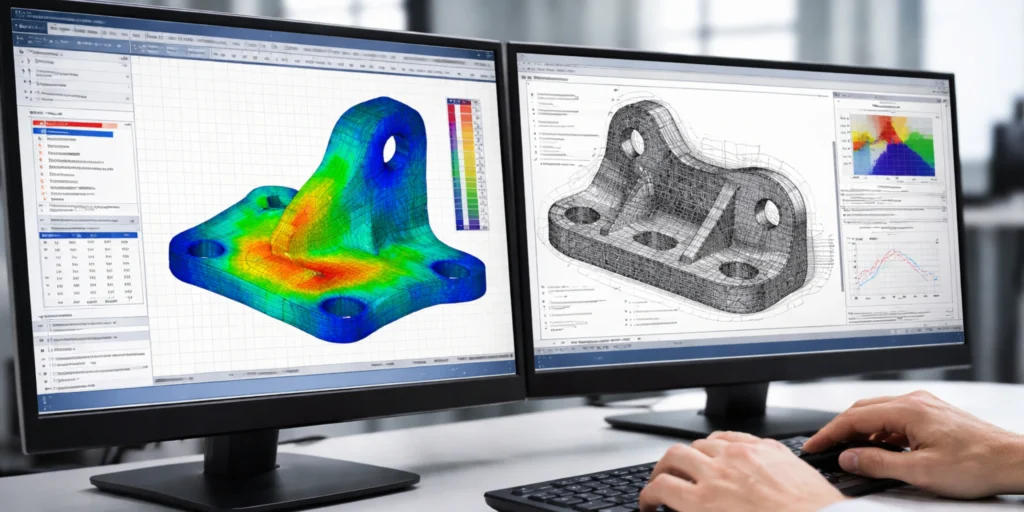
At ProtoTech Solutions, we have extensive experience in developing advanced CAD and geometry processing solutions for engineering software companies.
Our team helps organizations build reliable geometry handling modules for modern engineering platforms, including cloud-based simulation systems.
Our expertise includes:
- CAD data import from multiple systems and kernels
- Geometry healing and topology correction workflows
- Automatic and semi-automatic defeaturing
- Browser-based 3D geometry editing tools
- CAD kernel integration, such as Parasolid
- Preparation of simulation-ready models for meshing pipelines
We work with companies developing engineering SaaS platforms, CAD viewers, digital twin applications, and simulation tools, helping them transform raw CAD data into high-quality models ready for analysis.
Final Thoughts
As more engineering tools move toward cloud-based simulation platforms, geometry processing becomes a critical component of the overall system architecture. Without robust geometry healing, CAD models imported from different design systems can introduce errors that disrupt meshing and compromise simulation results.
By implementing reliable geometry healing workflows, SaaS-based FEA platforms can ensure that uploaded models are clean, consistent, and ready for simulation.
With deep expertise in CAD technologies and engineering software development, ProtoTech Solutions helps organizations build scalable geometry handling solutions that support the next generation of cloud-based engineering applications. Contact Us